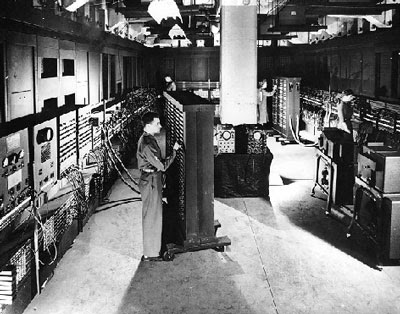
Personal computers are now commonplace in most homes throughout the world, and are relied on heavily by both individuals and businesses. The invention of the computer is relatively new, emerging into our lives relatively late in the 20th century. The technology to build such intricate and sophisticated systems was simply not available prior to this, though advancements in microelectronics made the vision of a computer a realistic one. The two innovations in electronics which allowed for this were the integrated circuit, which was manufactured in 1959, and the microprocessor, which appeared in 1971. The integrated circuit allowed the internal memory solutions to be shrunken down into manageable components, whereas the microprocessor reduced the size of a central processing unit down to a single chip.
The microprocessor revolutionised electronics as we know it, a small silicon chip which can process thousands of simultaneous calculations, and replace the need for thousands of independent transistors. Developed by Ted Hoff, in California, part of the Intel Corporation, the microprocessor opened up new opportunities for machines, as the processor itself was capable of handling large flows of data, performing logical calculations and almost behaving with intelligence.
The first desktop computer system was manufactured for person use in 1974, courtesy of Micro Instrumentation Telemetry Systems (MITS). The computer was termed Altair, and retailed for as little as $400. The popularity of the Altair soared to unimaginable heights, everyone appearing keen to sample this new machine. This sparked a whole host of computers being developed by other companies, or by young ambitious entrepreneurs. The first well known and reputable company to produce their own computer was Tandy Corporation, which launched its own model in 1977. This model proved a hit, and became the most popular of the computers on the market at that time for two main reasons. It included a keyboard, to improve input, and also included a cathode ray tube to provide a CTR monitor. It also allowed information to be stored on cassette tapes, and was also programmable.
A couple of engineers, Stephen Wozniack and Steven Jobs, then began their own business venture which would become known as Apple Computers. The pair manufactured the Apple I, which was a homemade microprocessor, from Jobs' parents' garage of all places. The Apple I was then marketed to the public and was later sold to electronics enthusiasts and hobbyists. This led to the creation of Apple Computer, Inc., and in April, 1977, the Apple II was launched, the world's first personal computer system. The system was designed exclusively by the Apple team and included a keyboard and most notably colour graphics. The Apple II retailed at $1290.
Apple introduced brand new features to its computer system, expandable memory, disk-drive systems, improved data storage, and the aforementioned colour graphics. Apple Computers became the fastest growing business in American business history, with rival companies being set up as a result of Apple's huge success.
1981 saw IBM introduce their model of microcomputer, generically named the IBM PC. The 16-bit microprocessor prompted cravings for faster and more powerful processors. In the middle of the 1980's, a few more improvements were introduced to the computer world. 32-bit computers were revealed, which allowed for enough power to prove beneficial in a small to medium business environment.
User friendliness was targeted as key for most computer users, and the development or a Graphical User Interface certainly epitomised this. The GUI, replaced the requirement of entering complex commands, and brought in a much simpler 'point and click' strategy. Douglas Engelbart created an "X-Y Position Indicator for a Display System": which effectively became the "mouse", which has obviously has remained a standard with modern day PC's. Voice recognition software now exists to rival mouse input, and computer technology continues to grow at earth shattering speeds, which opens up exciting ideas for the not so distant future of computers.
The invention of the computer was clearly one of the most revolutionary inventions ever to grace the business world.

 6:29 AM
 Techno

 Want one of your very own? You're out of luck buddy, because Peter only made one and he's not selling it. Maybe if you have seven months of your own free time, you can build your very own. And now for some pics...

 Want one of your very own? You're out of luck buddy, because Peter only made one and he's not selling it. Maybe if you have seven months of your own free time, you can build your very own. And now for some pics...

 Subscribe
 Follow me!

